
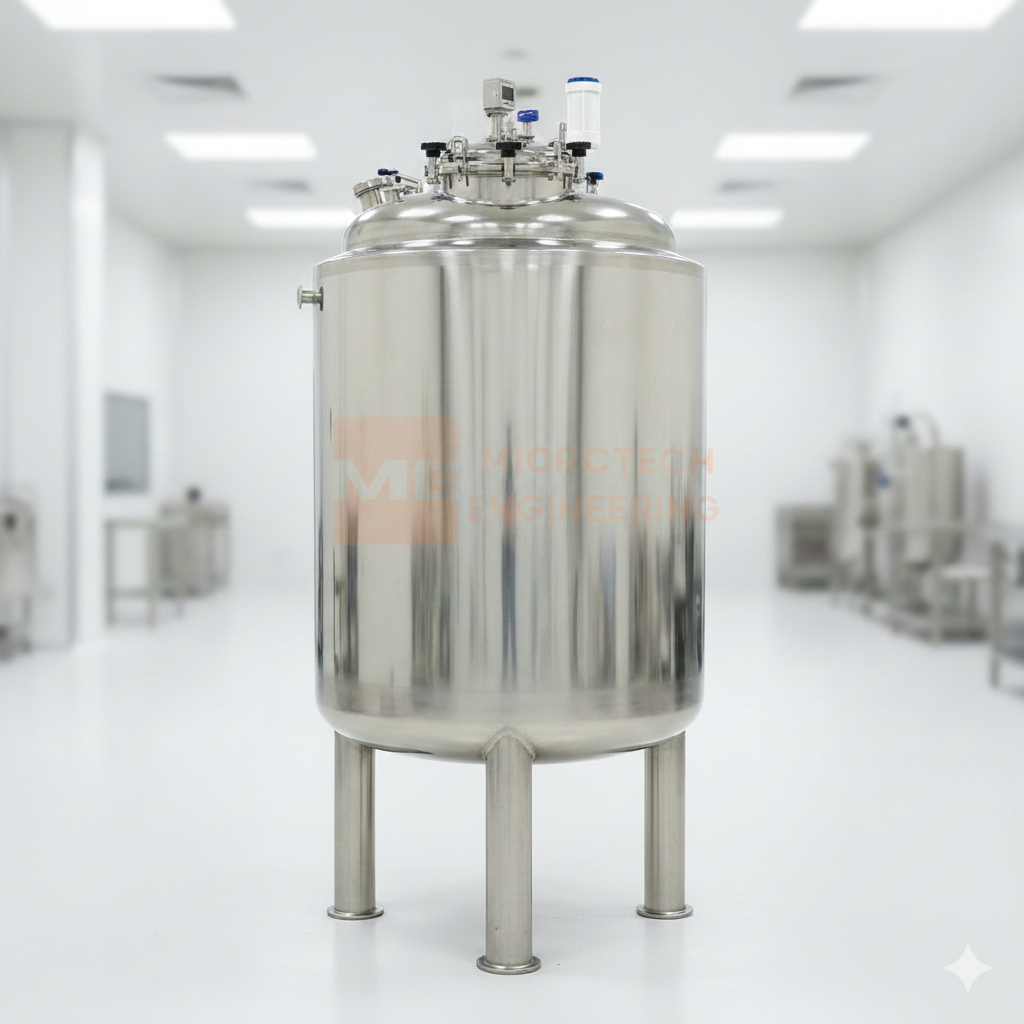
Water is the most widely used raw material in pharmaceutical manufacturing. It serves as an ingredient in formulations, a cleaning agent, and a utility fluid. Because of its critical role, pharmacopoeias establish strict standards for water quality. The two most common types are Purified Water (PW) and Water for Injection (WFI). In this article, we'll discuss how storage tank configurations differ between these two grades.
Purified Water (PW) vs. Water for Injection (WFI)
The primary difference between the two lies in their microbial limits and how they are prepared:
- PW: Used primarily as an excipient for non-sterile formulations (such as syrups, ointments, and tablets) and for initial equipment cleaning. Its bacterial limit is ≤ 100 CFU/mL.
- WFI: Used for sterile parenteral formulations (injectables, IV fluids, eye drops) and final rinsing. WFI must have a bacterial limit of ≤ 10 CFU/100mL and be virtually free of bacterial endotoxins.
How PW and WFI Storage Tank Designs Differ
1. Temperature & Sanitization Loops
Because WFI is used for sterile injectables, it must be kept free of microbial growth at all times. To achieve this:
- WFI Tanks are stored in a continuous circulation loop maintained at high temperatures (typically **70°C to 80°C**) to prevent any bacterial proliferation. They are jacketed and insulated to keep this heat uniform.
- PW Tanks can be stored at ambient temperatures, but require periodic sanitization (either thermally by heating up to 85°C, or chemically using ozone).
2. Internal Surface Roughness (Ra) & Electropolishing
Both tanks must be fabricated from SS 316L stainless steel, but their internal polish requirements differ:
- PW Storage Tanks: Typically require a mechanical mirror-polish with internal surface roughness of Ra ≤ 0.4 µm.
- WFI Storage Tanks: Mandate an even smoother finish. WFI tanks are typically electropolished to Ra ≤ 0.2 µm. Electropolishing removes microscopic peaks and valleys, leaving a chromium-rich, highly passive surface that resists bio-film accumulation.
3. Piping, Venting, and Spray Balls
Both PW and WFI storage vessels utilize sanitary spray balls for Clean-in-Place (CIP) actions, but WFI tanks are particularly sensitive to atmospheric contamination:
- Vent Filters: As water levels rise and fall inside the tank, air is breathed in and out. WFI tanks utilize 0.2-micron hydrophobic, steam-jacketed vent filters to prevent airborne microbes or moisture condensation from contaminating the sterile water.
- Zero Dead Leg Valves: Drain and outlet points must use zero-dead-leg diaphragm valves to ensure there are no stagnant pockets of water.
Summary Comparison Table
| Feature | PW Storage Tank | WFI Storage Tank |
|---|---|---|
| Material | SS 316L (Contact Part) | SS 316L (Contact Part) |
| Polish Finish | Ra ≤ 0.4 µm (Mechanical Mirror) | Ra ≤ 0.2 µm (Electropolished) |
| Storage Temp | Ambient (with periodic heat sanitation) | Continuous Hot Loop (70°C - 80°C) |
| Keep Vent Filter | 0.2 µm Hydrophobic Filter | 0.2 µm Hydrophobic (Steam Jacketed) |
Conclusion
When selecting a storage tank, the choice depends entirely on your final formulation guidelines. WFI storage tanks involve higher initial costs due to electropolishing and heating jacket loops, but they are absolutely essential for sterile injectable plants to meet WHO-GMP and FDA inspections.