
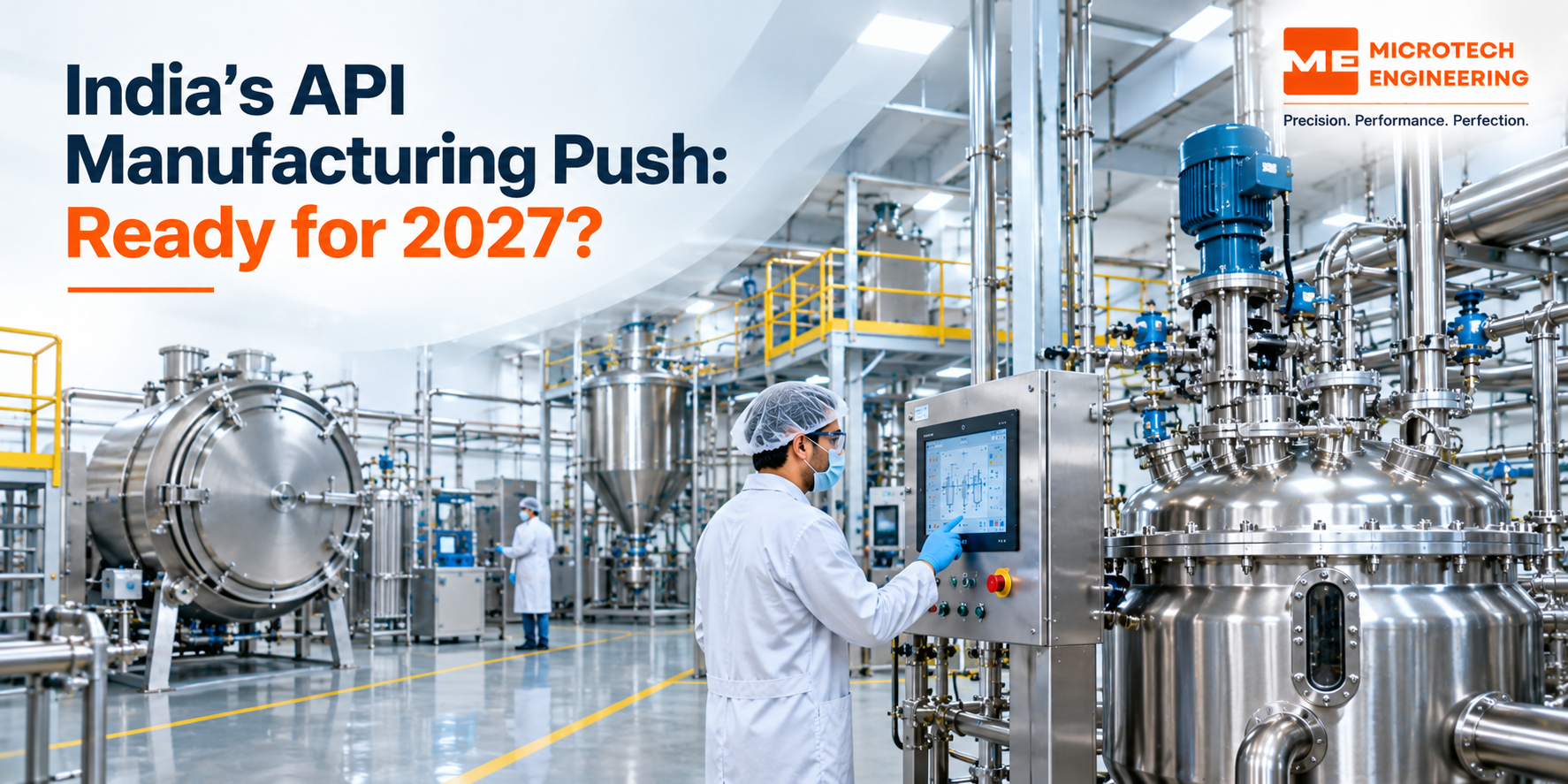
India’s pharmaceutical industry is entering an important phase of manufacturing development. As the country strengthens its domestic production capabilities, pharmaceutical companies are increasingly evaluating how to improve manufacturing infrastructure, reduce supply-chain vulnerabilities, modernise existing facilities and meet evolving quality expectations.
One of the most important areas of focus is Active Pharmaceutical Ingredient (API) manufacturing.
APIs are the active components responsible for the therapeutic effect of medicines. Their manufacturing involves complex chemical, physical and purification processes that require carefully selected equipment, controlled operating conditions and consistent quality management.
For Indian manufacturers, 2027 presents an opportunity to review existing production infrastructure and identify where equipment upgrades can improve process reliability, manufacturing efficiency, product quality and capacity.
Government initiatives supporting domestic API and bulk drug manufacturing are also contributing to this direction. The Production Linked Incentive (PLI) scheme for critical Key Starting Materials (KSMs), Drug Intermediates (DIs) and APIs aims to strengthen domestic manufacturing and reduce dependence on imports. In addition, the development of bulk drug parks is intended to improve access to common infrastructure such as utilities, water, steam and effluent treatment facilities.
However, increasing API manufacturing capacity requires more than establishing new production units. Manufacturers must also invest in appropriate process equipment, material handling, filtration, drying, cleaning, utilities and process monitoring.
This article explores the major equipment upgrades Indian API manufacturers should evaluate in 2027 and how a well-planned modernisation strategy can support long-term manufacturing growth.
1. Why API Manufacturing Is a Strategic Priority for India in 2027
India has an established pharmaceutical manufacturing base, but dependence on imported raw materials and certain critical intermediates remains an important supply-chain consideration.
Strengthening domestic API production can help improve supply resilience, support pharmaceutical exports and create opportunities for manufacturers across the bulk drug value chain.
Government Initiatives Supporting Domestic API Manufacturing
The Department of Pharmaceuticals is implementing the PLI scheme for domestic manufacturing of critical KSMs, DIs and APIs.
According to a Ministry of Chemicals and Fertilizers update published in March 2026:
- The scheme has a total outlay of ₹6,940 crore.
- It covers 41 identified critical products.
- 33 products had been subscribed.
- 48 greenfield projects had been approved.
- Investment of ₹4,814 crore had been made against the approved project commitments as of December 2025.
The government has also approved three bulk drug parks in Andhra Pradesh, Gujarat and Himachal Pradesh. These projects are intended to support common infrastructure, including power, water, steam, effluent treatment, solid waste management and warehousing.
These initiatives indicate the importance of building a stronger domestic API manufacturing ecosystem. They do not, however, mean that every manufacturer automatically qualifies for financial support or that every project has the same infrastructure requirements. [Sources: Department of Pharmaceuticals and Press Information Bureau, Government of India].
What This Means for Pharmaceutical Manufacturers
As domestic manufacturing capacity develops, companies may need to evaluate:
- Higher and more consistent production capacity
- Improved process repeatability
- Better equipment utilisation
- More efficient filtration and drying operations
- Improved material handling and containment
- Stronger cleaning and contamination controls
- Better documentation and process monitoring
- Infrastructure that supports future expansion
For existing manufacturers, upgrading selected equipment may be a practical way to address production constraints without immediately undertaking a complete plant redevelopment. Learn more about planning modular and scalable pharmaceutical facilities to adapt to expanding production targets.
2. The Major Manufacturing Challenges API Plants Must Address
Before investing in new equipment, manufacturers should understand the operational issues affecting their existing production processes.
2.1 Dependence on Ageing Equipment
Older equipment may have limitations in capacity, control accuracy, cleanability, maintenance access and process monitoring. As production requirements change, equipment that was suitable for an earlier product portfolio may become inefficient or difficult to operate consistently.
2.2 Process Variability
API manufacturing can involve multiple reaction, separation, purification and drying stages. Variations in temperature, agitation, pressure, filtration conditions, drying parameters or raw-material characteristics can influence process performance and product quality. Equipment upgrades should therefore focus on the actual process variables that require better control.
2.3 Filtration and Drying Bottlenecks
Filtration and drying can influence overall batch cycle time and production scheduling. If filtration capacity is insufficient or drying takes longer than expected, the entire manufacturing sequence may be delayed. Improving these operations can be an important part of a plant-capacity improvement programme.
2.4 Cleaning and Cross-Contamination Risks
Manufacturers producing multiple APIs or intermediates in shared equipment must evaluate cleaning effectiveness, residue carryover and product compatibility. Equipment design, surface accessibility, cleaning methods and documented cleaning validation all contribute to contamination control.
2.5 Utility and Energy Constraints
API manufacturing may involve significant requirements for heating, cooling, compressed air, water, steam and other utilities. Inadequate utility infrastructure can restrict production even when the primary process equipment has sufficient capacity. A complete equipment upgrade plan must therefore consider the supporting utility systems.
3. Essential API Manufacturing Equipment Upgrades for 2027
The right equipment configuration depends on the chemistry, process route, product characteristics, batch size, hazard profile and intended production capacity. The following equipment categories are worth evaluating when planning an API manufacturing upgrade.
3.1 Advanced Reactors and Process Vessels
Reactors are central to many API manufacturing processes. They are used for chemical reactions and other controlled processing operations, depending on the manufacturing route. For 2027, manufacturers should assess whether existing reactors provide suitable process control, capacity and operational reliability.
Important evaluation parameters include:
- Vessel capacity and working volume
- Material of construction and product compatibility (e.g. SS 316L, Hastelloy, or glass-lined)
- Agitation and mixing performance
- Heating and cooling arrangements
- Operating pressure and temperature limits
- Instrumentation and process monitoring
- Drainability, cleanability and maintenance access
For processes involving temperature-sensitive reactions, accurate temperature monitoring and suitable heat-transfer performance are particularly important. The selection of reactor design and materials should be based on process chemistry, compatibility requirements and applicable engineering standards.
Upgrade opportunity: Review existing reactors for capacity limitations, control-system improvements, mixing performance and maintenance requirements before deciding whether replacement or additional process vessels are necessary.
3.2 Filtration Systems for Improved Solid-Liquid Separation
Filtration is an important operation in API manufacturing, particularly where solids must be separated from liquids during intermediate processing or product recovery.
Depending on the process, manufacturers may use different filtration technologies, including filter press systems, pressure filtration systems and specialised pharmaceutical filtration equipment.
When reviewing filtration infrastructure, consider:
- Required filtration area
- Operating pressure and temperature
- Filter-media compatibility
- Cake formation and discharge requirements
- Product recovery and yield
- Cleaning and maintenance arrangements
- Containment and operator safety
A filter press system may be appropriate for certain solid-liquid separation applications, but it is not a universal solution for every API process. Manufacturers should evaluate filtration characteristics, particle properties, solvent compatibility and process requirements before selecting equipment.
Upgrade opportunity: Identify filtration as a potential production bottleneck and assess whether additional filtration capacity, improved filter-media selection or a modern pharmaceutical filter press arrangement could improve process performance.
3.3 Industrial Dryers for Controlled Moisture Removal
Drying is a critical stage in many API and intermediate manufacturing processes. After filtration or separation, materials may require controlled moisture or solvent removal before further processing, milling, blending or packaging.
Dryer selection depends on the material’s physical properties, thermal sensitivity, solvent characteristics and required final moisture level.
Key evaluation factors include:
- Drying capacity and batch size
- Heat-transfer method (convection, conduction, or radiation)
- Temperature control and uniformity
- Vacuum capability, where applicable
- Solvent compatibility and recovery arrangements
- Product discharge and handling
- Cleanability and inspection access
- Containment requirements
Upgrading to modern industrial pharmaceutical dryers such as stainless-steel air tray dryers ensures uniform airflow, precise thermal profiling, and compliance with strict moisture specifications without thermal degradation.
Upgrade opportunity: Review existing drying cycles to identify unnecessary processing time, inconsistent moisture levels, energy consumption and equipment-utilisation issues.
3.4 Milling and Size-Reduction Equipment
After drying, certain API intermediates or finished materials may require size reduction to achieve a suitable particle-size distribution. Milling equipment supports downstream processing by helping manufacturers achieve consistent material characteristics.
Equipment selection should consider:
- Feed material properties
- Required particle-size range
- Milling capacity and throughput
- Heat generation during milling
- Product sensitivity and degradation risks
- Dust containment
- Cleaning and changeover validation
- Material recovery and discharge
High-precision Pharmaceutical Multi Mill machines offer adaptable beaters, variable speed settings, and interchangeable screens suitable for a broad spectrum of pharmaceutical size-reduction and processing applications. However, they should not be treated as a universal substitute for specialized ultra-fine milling technologies used in high-potency or micronization processes.
Upgrade opportunity: Evaluate whether the existing milling arrangement provides the required throughput, particle-size consistency and containment for the material being processed.
3.5 Vibro Shifters and Screening Systems
Screening and sieving systems separate particles according to specified size ranges and remove oversize foreign particles or agglomerates. In API manufacturing, the appropriate screening method depends on the material’s characteristics, required particle-size distribution and process objective.
Important considerations include:
- Screen mesh specification and wire diameter
- Screening capacity and vibration amplitude
- Product characteristics (cohesive vs free-flowing)
- Dust containment and sealed transfer gaskets
- Material-contact surfaces (SS 316L finish)
- Cleaning and inspection access
- Equipment integration with upstream and downstream operations
Utilizing high-performance Vibro Shifter machines helps maintain product purity, uniform granulation grading, and seamless dust-tight transfer into intermediate bulk containers.
Upgrade opportunity: Assess whether screening performance, material transfer and cleaning arrangements are affecting the consistency or efficiency of downstream processing.
3.6 Blenders and Material-Handling Systems
Blending may be required in selected API manufacturing and downstream processing operations to achieve a specified material distribution or homogeneous batch lot. Blender selection should be based on powder characteristics, batch size, bulk density, flow properties and the required degree of mixing.
Manufacturers should also review how material is transferred into and out of the equipment. Modern pharmaceutical blending equipment such as stainless-steel octagonal blenders provides gentle tumbling action with low power consumption and high blend uniformity.
Supporting systems include:
- Stainless-steel intermediate containers
- IPC bin containers for dust-free storage and transfer
- Closed material transfer arrangements and valve systems
- Dedicated storage vessels
- Charging and discharge systems
- Dust-control and containment arrangements
Closed or controlled transfer systems help reduce unnecessary material exposure, eliminate airborne contamination, and protect operator health.
Upgrade opportunity: Review manual handling steps and evaluate whether suitable containers, bins or transfer systems can improve material movement, traceability and operator safety.
3.7 Storage Tanks and Process Vessels
Storage and holding systems are required at different stages of pharmaceutical manufacturing. Depending on the process, manufacturers may need vessels for intermediates, process liquids, purified water or other utilities.
When evaluating storage infrastructure, consider:
- Capacity and operating range
- Product or utility compatibility
- Material of construction and surface roughness (Ra < 0.4 µm)
- Surface finish, electropolishing, and cleanability
- Venting, rupture discs, and instrumentation
- Complete bottom drainability
- Temperature-control and jacket arrangements
- Inspection and maintenance access
Hygienic PW and WFI storage tanks with sanitary spray balls and continuous recirculation loops prevent microbial biofilm formation and ensure compliance with pharmacopoeial standards. Storage capacity should be aligned with actual process demand and the production schedule; an oversized tank is not necessarily beneficial if it creates additional cleaning, maintenance or process-control challenges.
4. Advanced Manufacturing Trends API Plants Should Prepare For
Equipment upgrades in 2027 should not be limited to replacing old machines with newer models. Manufacturers should also evaluate technologies and engineering approaches that improve process visibility, operational flexibility and quality management.
4.1 Process Automation and Instrumentation
Modern instrumentation can help operators monitor critical process parameters and respond to deviations more consistently. Depending on the manufacturing process, relevant measurements include:
- Temperature and thermal gradients
- Pressure and vacuum levels
- Agitation speed and torque
- Flow rate and mass addition
- Liquid level and foam detection
- Conductivity, pH, or dissolved oxygen, where relevant
- Drying parameters (exhaust humidity, bed temperature)
- Equipment operating status and cycle times
Automation may include PLC/SCADA process controllers, recipe management, alarm routing, batch monitoring and enterprise data integration. The level of automation should be determined by process complexity, risk, business requirements and the manufacturer’s quality system. Computerised systems that affect regulated activities require appropriate validation (GAMP 5), access controls, audit trails, data integrity safeguards (21 CFR Part 11) and change management.
4.2 Continuous Manufacturing and Process Intensification
Continuous manufacturing is an important area of pharmaceutical manufacturing development. Unlike traditional batch production, continuous processes operate with a continuous flow of materials through connected processing stages.
Potential advantages may include improved process control, smaller process inventories, reduced footprint, and more consistent operation when the process is appropriately designed and controlled.
However, continuous manufacturing is not suitable for every API or chemical process. Manufacturers considering it should evaluate:
- Reaction kinetics and process chemistry
- Material-flow and rheological characteristics
- Residence-time distribution requirements
- Process analytical technology (PAT) capability
- Real-time release testing (RTRT) and control strategy
- Continuous process monitoring
- Product quality, traceability, and validation requirements
For many Indian manufacturers, the practical first step may be to improve process monitoring and identify suitable opportunities for process intensification (e.g. continuous crystallization or microreactors) rather than immediately converting an entire facility to continuous manufacturing.
4.3 Process Analytical Technology (PAT)
PAT involves using appropriate analytical and measurement tools to understand and control manufacturing processes in real time. Depending on the application, it may include spectroscopy (NIR, Raman, FTIR), particle-size sensors, online chromatography, and other in-line analytical techniques.
PAT can support better process understanding, optimize endpoint detection in crystallization or drying, and help manufacturers identify variations during production. However, selecting PAT tools requires a comprehensive understanding of the process, critical quality attributes (CQAs), critical process parameters (CPPs), analytical performance and control strategy.
4.4 Digital Monitoring and Predictive Maintenance
Digital monitoring can help maintenance and engineering teams understand equipment health and operating trends. Potential applications include:
- Monitoring cumulative equipment operating hours
- Tracking temperature and vibration trends on bearings, motors, and agitator gearboxes
- Recording equipment alarms and deviation frequencies
- Identifying recurring downtime causes
- Scheduling predictive and preventive maintenance
- Monitoring utility consumption (steam, power, cooling water, chilled brine)
Predictive maintenance should be based on reliable sensor data and equipment-specific failure patterns. It should complement, rather than automatically replace, preventive maintenance and established regulatory inspection programmes.
4.5 Modular and Scalable Equipment Configurations
As API manufacturers expand production, equipment layouts should allow for future capacity additions wherever practical. Modular process skids, standardised connections and coordinated utility interfaces simplify installation and expansion activities.
Manufacturers should assess future requirements for additional processing vessels, filtration and drying capacity, material storage, utility distribution headers, maintenance access, and equipment replacement. The goal is to plan for realistic growth without investing in unnecessary idle capacity upfront.
5. GMP, Quality and Compliance: What Equipment Upgrades Must Address
Equipment modernisation should be planned alongside pharmaceutical quality requirements. In India, revised Schedule M requirements are an essential consideration for pharmaceutical manufacturers. The revised requirements were notified through G.S.R. 922(E) dated 28 December 2023, and CDSCO issued communications asking manufacturers to undertake the necessary compliance actions following a structured gap assessment.
For API manufacturing, the applicable GMP framework (including ICH Q7 Good Manufacturing Practice Guide for Active Pharmaceutical Ingredients) and regulatory requirements should be reviewed according to the product, manufacturing activity and markets served. The following areas deserve particular attention:
- Equipment Design and Construction: Equipment must be suitable for its intended use, appropriately sized and designed to support cleaning, maintenance and product-quality requirements. Product-contact materials must be non-reactive, non-additive, and compatible with the materials being processed.
- Cleaning and Cleaning Validation: Where equipment is shared between products or manufacturing stages, cleaning effectiveness, swab/rinse recovery, and potential carryover limits (MACO) must be assessed. Cleaning validation should reflect actual equipment use and the risks associated with residues, product potency, toxicity and stability.
- Equipment Qualification: New or modified equipment requires documented qualification activities according to its intended use and impact on product quality. This includes User Requirement Specifications (URS), Design Qualification (DQ), Installation Qualification (IQ), Operational Qualification (OQ), and Performance Qualification (PQ).
- Documentation and Traceability: Equipment identification tags, maintenance logs, standard operating procedures (SOPs), calibration records and batch production records should be systematically maintained within the pharmaceutical quality system (PQS).
- Containment and Personnel Safety: For potent, sensitising, toxic or otherwise hazardous compounds (including high-potency APIs with OEL < 10 µg/m³), manufacturers should evaluate containment based on a documented occupational and process risk assessment. The equipment, transfer systems, dust-control arrangements and cleaning methods must be appropriate to the material’s hazard characteristics.
Important Compliance Note:
Purchasing equipment described as GMP-compliant does not automatically make a manufacturing process or facility compliant. Suitability, proper installation, documented qualification, cleaning validation and ongoing operational adherence all matter.
6. How Indian API Manufacturers Can Prioritise Equipment Investments in 2027
A complete plant modernisation project can require significant capital investment. Manufacturers should therefore prioritise upgrades based on measurable production needs and risk profiles.
A practical approach is to classify equipment requirements into three distinct categories:
| Priority | Upgrade Area | Business Objective |
|---|---|---|
| High | Critical process equipment, filtration, drying and essential utility constraints | Address immediate production bottlenecks, yield losses, and reliability risks |
| Medium | Material handling, milling, screening and process instrumentation | Improve operational consistency, containment, and material movement |
| Strategic | Advanced automation, PAT, continuous processing and modular expansion | Prepare for longer-term process development, data integrity, and scalable growth |
The exact priorities will vary according to the facility’s specific process chemistry, product portfolio and existing infrastructure constraints.
Conduct a Manufacturing Equipment Audit
Before selecting equipment, conduct a structured engineering audit of the current facility. Assess:
- Existing equipment condition, material fatigue, and age
- Current production capacity vs. actual operational utilisation
- Batch cycle time and stage-by-stage cycle duration
- Filtration throughput and drying cycle performance
- Unplanned equipment downtime and recurring failure modes
- Cleaning, changeover, and line-clearance turnaround times
- Utility availability and peak loads (steam, chilled water, nitrogen)
- Maintenance costs and spare-parts availability
- Quality deviations and OOS results linked to equipment variability
- Future product pipeline and batch-size requirements
This review helps distinguish equipment that genuinely needs replacement from units that may benefit from minor refurbishment, improved seals, updated instrumentation, or optimized process controls.
Compare Investment Against Operational Impact
For each proposed upgrade, estimate the complete lifecycle impact:
- Capital expenditure (CapEx)
- Installation, civil/piping modifications, and commissioning cost
- Qualification and validation expenditure
- Expected throughput improvement and cycle-time reduction
- Potential reduction in unplanned maintenance downtime
- Ongoing maintenance and utility operating costs (OpEx)
- Expected equipment service life and residual value
- Flexibility for future portfolio expansion
A well-supported investment decision should be based on the total cost of ownership (TCO) and operational risk reduction rather than purchase price alone.
7. Common Mistakes to Avoid During API Plant Modernisation
Mistake 1: Selecting equipment based only on price
A lower initial purchase price often hides elevated lifecycle costs, recurring maintenance issues, poor weld finishes, or inadequate qualification documentation.
Better approach: Evaluate total lifecycle cost, technical build quality, metallurgy certification, and vendor qualification support.
Mistake 2: Increasing capacity without analysing bottlenecks
Adding a larger reactor yields minimal output gains if downstream filtration, drying, or powder handling remains constrained.
Better approach: Model the complete manufacturing sequence and debottleneck filtration and drying alongside reactor capacity.
Mistake 3: Ignoring product compatibility
Corrosive solvents, acidic reaction media, or halogenated compounds can rapidly degrade standard stainless steel, leading to product contamination.
Better approach: Prepare detailed process chemistry specifications and select suitable materials of construction, coatings, and FDA-compliant elastomer gaskets.
Mistake 4: Underestimating cleaning requirements
Equipment with dead legs, rough interior welds, or inaccessible internal geometries creates severe cleaning validation failures and carryover risks.
Better approach: Prioritize sanitary design, electropolished surfaces, spray-ball coverage validation, and CIP-friendly drainability.
Mistake 5: Introducing automation without clear requirements
Over-automating without clear process parameters can create complex software maintenance burdens and expensive validation overhead.
Better approach: Pinpoint critical control parameters (CPPs), establish a rigorous URS, and implement fit-for-purpose automation with validated audit trails.
Mistake 6: Overlooking supporting utilities
Installing modern high-capacity reactors or dryers without assessing boiler steam capacity, chilled water, or nitrogen generation causes immediate operational stalling.
Better approach: Perform a comprehensive utility balance assessment before finalizing equipment procurement and installation.
8. A Practical Equipment Modernisation Roadmap for 2027
API manufacturers can adopt a phased engineering roadmap to plan and execute plant upgrades with minimal disruption:
- Phase 1: Assessment
Review current equipment performance and maintenance records. Identify recurring process bottlenecks. Document immediate and medium-term product capacity targets. Conduct a comprehensive GMP, revised Schedule M, and engineering gap assessment. - Phase 2: Equipment Planning
Develop detailed User Requirement Specifications (URS). Define critical process parameters and operating ranges. Assess metallurgy, contact materials, and solvent compatibility. Establish cleaning, containment, and operator safety criteria. Model required utility header and distribution upgrades. - Phase 3: Procurement and Engineering
Perform technical and quality audits of equipment manufacturers. Review detailed engineering drawings, P&IDs, and fabrication specifications. Confirm site delivery, layout clearance, and installation routes. Coordinate procurement timelines with planned facility shutdown schedules. - Phase 4: Installation and Qualification
Supervise mechanical and electrical installation against approved engineering drawings. Execute commissioning and formal qualification protocols (IQ/OQ/PQ). Calibrate instrumentation, temperature sensors, and pressure transmitters. Train operators and establish revised SOPs, maintenance procedures, and cleaning validation protocols. - Phase 5: Performance Monitoring
Track post-installation equipment utilisation, batch cycle times, and operational uptime. Monitor yield improvements and product-quality consistency. Review preventive maintenance feedback and spare-parts consumption. Identify subsequent opportunities for debottlenecking and capacity optimization.
9. How Microtech Engineering Supports Pharmaceutical Manufacturing Infrastructure
As Indian pharmaceutical manufacturers review their production infrastructure for 2027, selecting dependable, high-precision process equipment is a fundamental step in achieving regulatory compliance and sustained commercial growth.
Microtech Engineering manufactures robust, cGMP-compliant equipment engineered specifically for demanding pharmaceutical, chemical, and bioprocessing environments, including:
- Liquid Oral Processing Plants for automated, closed-loop liquid and suspension manufacturing
- Ointment and Cream Manufacturing Plants engineered for high-viscosity emulsions with integrated vacuum homogenizers
- PW and WFI Storage Tanks built to ASME BPE standards with sanitary spray systems and continuous recirculation
- Pressure Vessels and reaction tanks custom-fabricated for high-temperature and pressurized chemical processing
- Pharmaceutical Filter Press Systems providing efficient solid-liquid separation and high cake recovery
- Vibro Shifter Machines offering dust-tight, multi-deck screening and particle separation
- Pharmaceutical Multi Mill Machines engineered for precision granulation and uniform particle size reduction
- IPC Bin Containers providing dust-free intermediate powder handling, blending, and dispensing
- Industrial Pharmaceutical Dryers including stainless-steel air tray dryers with precise thermal airflow
- Pharmaceutical Blending Equipment including octagonal and double-cone blenders for gentle, uniform powder distribution
For API manufacturers, equipment selection begins with a rigorous evaluation of the process chemistry, working batch sizes, contact materials, operating parameters, cleaning procedures, and utility availability. Not every equipment category is suitable for every API route; specialized synthesis, crystallization, solvent recovery, and high-containment operations require dedicated engineering specifications.
Planning an API Manufacturing Plant Upgrade for 2027?
Connect with the engineering experts at Microtech Engineering to discuss your process requirements and configure modern, GMP-compliant equipment solutions.
Conclusion
India’s API and advanced manufacturing push is opening decisive opportunities for pharmaceutical manufacturers to secure supply chains, increase export competitiveness, and build resilient production operations. Achieving these strategic milestones requires systematic modernisation of equipment across reaction, solid-liquid separation, drying, size reduction, blending, and bulk material handling.
By pairing focused equipment upgrades with robust cGMP compliance, revised Schedule M readiness, and automated process controls, Indian API plants can achieve higher throughput, superior product consistency, and sustainable commercial expansion heading into 2027 and beyond.