
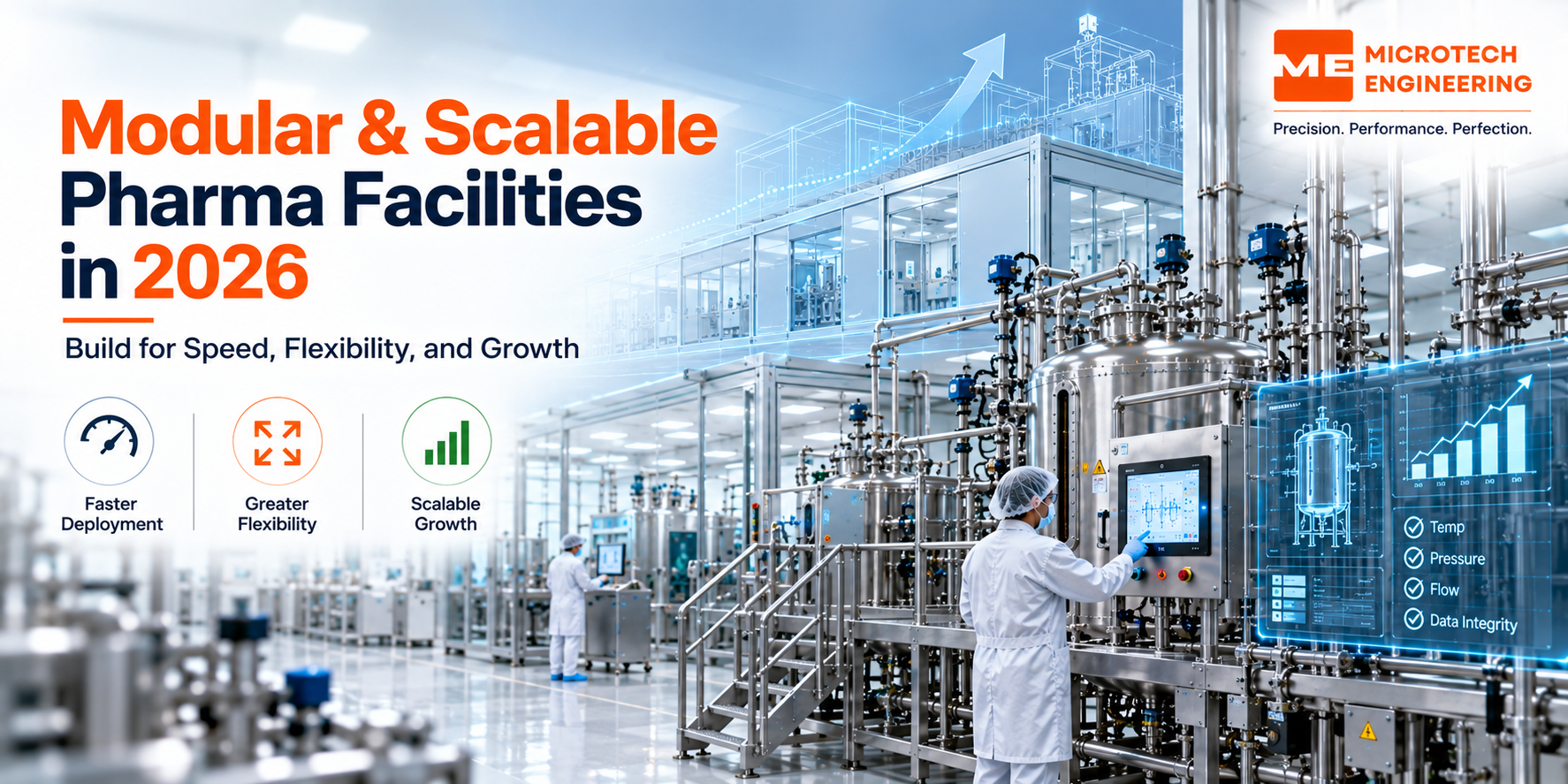
The pharmaceutical manufacturing landscape is evolving rapidly. Manufacturers must respond to changing product portfolios, tighter project timelines, increasing quality expectations and the need to manage capital expenditure carefully. A facility designed only for today's production requirements may become a constraint when demand increases or a new product requires a different manufacturing process.
This is where modular and scalable pharmaceutical facility design becomes an important strategic consideration.
Instead of treating a pharmaceutical plant as a fixed structure that is difficult to modify, manufacturers can plan production areas, process equipment, utilities and supporting infrastructure around future expansion. The objective is to make capacity additions and operational changes more manageable without compromising product quality, personnel safety or regulatory compliance.
In India, this approach is relevant to established pharmaceutical companies expanding their facilities, emerging manufacturers planning their first production units, and contract development and manufacturing organisations (CDMOs) serving multiple customers with advanced modular pharma facilities and process equipment.
The International Society for Pharmaceutical Engineering (ISPE) has highlighted flexibility, modularity, digital integration and future-ready facility design as important themes in pharmaceutical manufacturing. Its coverage of the 2026 Facilities of the Future programme also illustrates how manufacturers are rethinking the relationship between facility design and changing production needs. [Source: ISPE].
This guide explains how Indian pharmaceutical manufacturers can approach modular and scalable facility planning in 2026, what equipment and infrastructure deserve attention, and how to balance flexibility with GMP requirements.
1. What Is a Modular Pharmaceutical Facility?
A modular pharmaceutical facility is designed using defined, coordinated units that can be installed, configured, expanded or adapted according to manufacturing requirements.
Modularity can apply to different parts of a facility, including:
- Production rooms and manufacturing suites
- Process equipment and equipment skids
- Utility distribution systems
- Instrumentation and automation architecture
- Material handling and transfer systems
- Cleaning and process-support infrastructure
The term does not necessarily mean that an entire pharmaceutical plant is built from prefabricated containers. A facility may use conventional construction while incorporating modular process systems, standardized equipment interfaces and expansion-ready utilities.
For example, a manufacturer planning a liquid oral formulation plant could initially install the required mixing and storage vessels, transfer arrangements and supporting systems for its first production capacity. The original design could also reserve suitable space and utility capacity for an additional processing line.
When production demand increases, the company can evaluate the additional equipment and infrastructure needed without redesigning the entire facility from scratch.
The exact level of modularity depends on the product, process, site constraints, regulatory expectations and investment plan.
2. Modular vs. Scalable vs. Flexible Pharma Manufacturing
These terms are related, but they describe different aspects of facility planning.
| Concept | What It Means | Practical Example |
|---|---|---|
| Modular design | Manufacturing systems are organized into defined units or packages | A process vessel and its associated controls supplied as an integrated skid |
| Scalable design | Production capacity can increase as business requirements grow | Adding another vessel or production line to support higher output |
| Flexible design | The facility can accommodate different products, batch sizes or operating requirements | Configuring equipment and production areas for multiple compatible product types |
A well-planned pharmaceutical facility may incorporate all three.
However, flexibility should not be confused with unrestricted product changeover. Manufacturing different products in the same area may require documented risk assessment, cleaning validation, containment measures, segregation and additional qualification.
Similarly, increasing vessel size or adding a production line does not automatically guarantee that the complete process can operate at the intended scale. Mixing performance, heat transfer, process times, utilities and product quality must be assessed.
3. Why Modular and Scalable Pharma Facilities Matter in 2026
3.1 Changing Product Portfolios
Pharmaceutical companies may expand from established formulations into new strengths, dosage forms, complex products or additional customer requirements.
A rigid facility can make such changes expensive if the original layout does not allow for new equipment, different material flows or revised environmental controls.
Modular planning encourages manufacturers to identify which systems are likely to remain stable and which may need to change over time.
For example, common equipment interfaces and standardized utility connections can make future equipment installation easier to plan, provided the new equipment is suitable for the intended process.
3.2 Faster Capacity Expansion
When a facility is approaching its production limits, management may need to decide whether to add equipment, introduce another shift, improve utilisation or develop a new production area.
A scalable design supports this decision by identifying expansion options early.
Planning should consider more than floor space. Electrical loads, water and steam demand, HVAC capacity, drainage, compressed air, access routes and maintenance clearances can all become bottlenecks during expansion.
3.3 Better Control Over Capital Expenditure
Building every possible production line at the beginning may require significant upfront investment before demand has been established.
A phased development approach can help align capital spending with actual business requirements.
Under this approach, manufacturers can prioritise essential production equipment and critical infrastructure while evaluating which future investments can be deferred.
However, installing spare capacity everywhere is not automatically cost-effective. Oversized utilities, unused equipment and unnecessarily large production areas can increase capital and operating costs.
The objective is to identify where advance investment reduces future disruption and where staged investment makes more financial sense.
3.4 Support for Contract Manufacturing
CDMOs and contract manufacturers often face changing product mixes, customer requirements and production schedules.
Their facility design may need to support different batch sizes, compatible product families and varying equipment configurations.
Modular equipment arrangements can improve operational flexibility, but the facility must still provide appropriate controls for product segregation, material traceability, cleaning and changeover.
The business case is strongest when the expected product mix and future operating scenarios are understood before the design is finalised.
3.5 Long-Term Adaptability
Pharmaceutical assets are expected to operate over extended periods, while manufacturing technology and product requirements continue to evolve.
A future-ready facility considers how equipment will be replaced, maintained, upgraded or supplemented throughout its lifecycle.
ISPE's reporting on modular pharmaceutical facilities provides examples of how standardized interfaces and adaptable production areas can support changes in manufacturing requirements. Such examples demonstrate a design direction, not a guarantee that every modular project will achieve the same outcomes. [Source: ISPE Facility of the Year Awards].
4. How to Design a Scalable Pharmaceutical Manufacturing Facility
A scalable facility should be planned around the complete manufacturing process rather than individual machines in isolation.
Step 1: Define the Production Roadmap
Start by documenting the facility's current requirements and anticipated changes. Consider:
- Current products and dosage forms
- Expected batch sizes and annual production volumes
- Number of shifts and equipment utilisation
- Future product introductions
- Cleaning and changeover requirements
- Export-market and customer expectations
- Planned expansion over the next three to five years
Forecasts should include realistic scenarios rather than relying on a single growth assumption. A useful approach is to model a base case, a higher-demand case and a delayed-growth case. This helps the project team understand which investments are essential now and which can be phased.
Step 2: Map the Complete Process Flow
Document the movement of raw materials, intermediate products, finished products, personnel and waste. The layout should minimise unnecessary movement, avoid avoidable crossovers and support appropriate segregation.
For sterile products, potent compounds, sensitising materials or other higher-risk operations, the required containment and contamination-control strategy can substantially influence facility design.
The International Council for Harmonisation's ICH Q9 guideline on quality risk management identifies facility and equipment design, material and personnel flow, contamination prevention and qualification as important risk-management considerations. [Reference: ICH Q9 Quality Risk Management].
Step 3: Identify the Right Level of Modularity
Not every component needs to be modular. A manufacturer may benefit from modular process skids, standardized equipment connections and expansion-ready utility headers while retaining a conventional building layout. Another facility may require prefabricated rooms, specialised containment arrangements or more adaptable production areas.
Evaluate each proposed module against:
- Process suitability
- Installation and commissioning requirements
- Cleaning and maintenance access
- Connection and interface requirements
- Future replacement or relocation needs
- Qualification and validation implications
The best design is the one that improves the facility's actual operating model, not the one with the highest number of modular components.
Step 4: Plan Utilities Before Adding Capacity
Utility infrastructure can become one of the most difficult parts of a pharmaceutical plant to expand. Depending on the process, the design may need to account for purified water (PW), water for injection (WFI), clean steam, compressed air, process gases, electrical distribution, chilled water and HVAC.
Not all facilities require every utility. Requirements depend on the products, manufacturing process and applicable standards. For each utility, establish current demand, expected future demand, peak loads, redundancy requirements and available space for additional distribution.
Expansion plans should also consider water-system design, hygienic piping, drainage, utility monitoring and the effect of modifications on system qualification.
Important: Providing additional utility capacity is not a substitute for assessing the quality and suitability of the utility for its intended pharmaceutical application.
Step 5: Standardise Interfaces and Documentation
Standardisation can simplify future equipment installation and integration. Where appropriate, establish common requirements for:
- Equipment connection points
- Electrical and instrumentation interfaces
- Control-system architecture
- Data and communication protocols
- Equipment identification and documentation
- Maintenance access and spare parts
- Supplier documentation and handover
Standardisation should be based on engineering requirements and agreed specifications. It should not prevent the use of specialised equipment where the process requires it.
Step 6: Design for Qualification and Change Control
A modular or scalable facility must still be appropriately qualified and validated. Changes to equipment, utilities, software, room layouts or product flows can affect the validated state of the facility.
Before implementing a change, manufacturers should assess its potential impact on product quality, process performance, cleaning, contamination control, data integrity and regulatory commitments.
The required qualification, validation, testing and documentation should be determined through the pharmaceutical quality system and a documented risk-based approach. Modularity may simplify some engineering activities, but it does not eliminate GMP obligations.
5. Process Equipment That Supports Scalable Pharma Manufacturing
For manufacturers planning new facilities or expansion projects, equipment selection is central to the overall design. The right configuration depends on the dosage form, process parameters, product characteristics, batch sizes and applicable GMP requirements.
5.1 Mixing Vessels and Manufacturing Tanks
Mixing vessels and manufacturing tanks are used across multiple pharmaceutical processes, including the preparation of liquid formulations and other suitable products.
When selecting a vessel, evaluate:
- Working volume and operating range
- Product-contact material and surface finish (e.g. SS 316L, Ra < 0.4 μm)
- Agitation and mixing requirements
- Heating and cooling requirements
- Drainability and cleanability
- Instrumentation and process controls
- Access for inspection and maintenance
A vessel selected for today's batch size may not suit a future formulation or operating range. Manufacturers should therefore assess anticipated process requirements before finalising vessel capacity. Where additional vessels may be required, the facility layout should account for installation routes, foundations or supports, utility connections and maintenance access.
5.2 Liquid Oral Processing Plants
Liquid oral manufacturing may involve raw-material preparation, mixing, dissolution or dispersion, holding, transfer and downstream filling with integrated liquid oral processing plants.
A scalable layout should consider how these operations connect and how the facility will accommodate higher throughput. Key planning factors include:
- Batch preparation and holding capacity
- Transfer-pump and piping suitability
- Product temperature and mixing requirements
- Cleaning and changeover arrangements
- Availability of downstream filling capacity
- Utility demand during simultaneous operations
Adding a larger mixing vessel alone may not increase finished output if filling, holding, cleaning or material preparation remains the limiting step.
5.3 Ointment and Cream Manufacturing Plants
Ointments, creams and similar semisolid products may require controlled heating, mixing, homogenisation and product transfer utilizing specialized ointment and cream manufacturing plants.
A scalable system should be evaluated for batch-volume flexibility, mixing performance, temperature control, discharge arrangements and cleaning requirements.
The equipment configuration must match the formulation's viscosity, sensitivity to shear, temperature profile and other relevant process characteristics. Future capacity additions should also consider whether downstream transfer and filling systems can handle the intended product and throughput.
5.4 PW and WFI Storage Systems
Water systems can be critical to pharmaceutical manufacturing, depending on the intended use of the water. High-integrity PW and WFI storage tanks form the backbone of pharmaceutical utility systems.
Expansion planning should consider storage capacity, demand patterns, distribution-loop design, sanitisation strategy, monitoring, return flow and the impact of additional users on system performance. For WFI and other controlled pharmaceutical utilities, applicable pharmacopoeial and regulatory requirements must guide the design.
A larger storage tank does not automatically solve a capacity problem if generation, distribution, sanitisation or water quality is the actual constraint.
5.5 CIP and Cleaning Infrastructure
Cleaning systems should be considered early in the facility design, particularly where multiple products or equipment trains share manufacturing areas.
Depending on the process, a cleaning-in-place (CIP) arrangement may support repeatable cleaning of suitable equipment and pipework without dismantling every component. Design considerations include:
- Equipment and circuit coverage
- Cleaning-agent preparation and supply
- Flow, temperature and other required parameters
- Drainability and prevention of residue accumulation
- Cleaning verification or validation requirements
- Documentation and control of cleaning cycles
CIP suitability must be assessed for the specific equipment and process. It is not a universal replacement for manual cleaning or other cleaning methods.
5.6 Material Handling and Storage Equipment
Material movement can become a bottleneck as production grows. Suitable storage tanks, containers, transfer arrangements and handling systems can help organise raw materials, intermediates and finished products.
The design should account for identification, traceability, segregation, ergonomics and the prevention of mix-ups. As the facility expands, manufacturers should review the movement of materials between storage, dispensing, production, cleaning and dispatch areas.
6. Modular Equipment vs. Conventional Fixed Installations
Both approaches can be appropriate. The choice depends on the process, site and expected operating life.
| Evaluation Factor | Modular Equipment Approach | Conventional Fixed Installation |
|---|---|---|
| Installation | May support preassembly and coordinated installation | May require more site-based assembly |
| Future changes | Can simplify some equipment changes where interfaces are standardised | Changes may require more extensive site modifications |
| Initial investment | Depends on engineering scope, prefabrication and supplier capability | Depends on construction, equipment and installation requirements |
| Space utilisation | Modules may simplify defined layouts but require access and service space | Can be tailored closely to site constraints |
| Maintenance | Replaceable modules may simplify some interventions | Fixed systems can be straightforward to maintain when well designed |
| Qualification | Requires appropriate assessment and qualification | Also requires appropriate assessment and qualification |
Neither approach is universally faster or cheaper. Total project cost should include design, fabrication, transport, installation, utilities, commissioning, qualification, maintenance and future modification.
For some manufacturers, a hybrid model—conventional building infrastructure combined with modular process equipment—may provide a practical balance.
7. How Automation Supports Scalable Pharma Facilities
Automation can help manufacturers manage increasingly complex operations, provided it is designed around the actual process and quality requirements.
A scalable automation architecture may include:
- Process instrumentation and control systems
- Automated recipe execution where suitable
- Alarm management and event records
- Equipment-status monitoring
- Batch and production data integration
- Maintenance and performance monitoring
- Interfaces with manufacturing execution or enterprise systems, where appropriate
When planning automation, manufacturers should consider system capacity, communication interfaces, cybersecurity, user access, data integrity and lifecycle support.
Changes to control software or automated recipes may require documented testing, change control and validation, depending on their impact. Digital integration should not be added solely for appearance. Each system should address a defined operational, quality or compliance need.
8. Common Mistakes to Avoid When Planning a Modular Pharma Plant
- Designing only for initial production: A layout that works for the first production line may create problems when new equipment, storage or personnel routes are introduced. Better approach: Develop an expansion master plan before finalising the original layout.
- Oversizing every utility: Installing excessive capacity across every utility can increase investment and operating costs without creating meaningful value. Better approach: Assess demand scenarios, peak loads and realistic expansion requirements for each utility.
- Treating modularity as a shortcut to GMP compliance: A prefabricated room or preassembled skid is not automatically compliant or qualified for pharmaceutical manufacturing. Better approach: Define acceptance criteria, material requirements, testing, documentation and qualification responsibilities at the beginning of the project.
- Ignoring cleaning and product changeover: Equipment that accommodates multiple batches may still present contamination or residue risks. Better approach: Evaluate product compatibility, equipment cleanability, cleaning procedures and cross-contamination controls before approving shared use.
- Expanding one machine without reviewing the complete process: Increasing the capacity of a single unit may simply move the bottleneck to another operation. Better approach: Assess the entire manufacturing sequence, including preparation, processing, holding, transfer, cleaning and filling.
- Selecting equipment without considering future maintenance: Equipment may be difficult to service if the original layout leaves insufficient space for access, removal or replacement. Better approach: Include maintenance and equipment-replacement routes in the layout review.
9. A Practical Roadmap for Indian Pharmaceutical Manufacturers
A phased roadmap can help companies move from concept to an expansion-ready facility:
- Phase 1: Requirements and Feasibility – Define products, batch sizes and expected throughput. Review the current facility and identify capacity constraints. Develop future-demand scenarios. Establish preliminary investment and compliance requirements.
- Phase 2: Process and Facility Design – Map personnel, material and product flows. Define equipment and utility requirements. Identify modular systems and expansion zones. Review environmental controls, cleaning and maintenance access.
- Phase 3: Engineering and Procurement – Prepare user requirements and equipment specifications. Establish interface and documentation standards. Assess suppliers based on technical capability and support. Coordinate equipment delivery with construction and utility readiness.
- Phase 4: Installation and Qualification – Verify installation against approved specifications. Complete applicable commissioning and qualification activities. Assess automation and utility performance. Complete required validation, documentation and training.
- Phase 5: Performance Review and Expansion – Monitor utilisation, throughput, changeover time and downtime. Compare actual demand with the original forecast. Identify bottlenecks before committing to additional equipment. Update the expansion plan through formal change control.
The sequence and scope will vary with the facility type, project complexity and regulatory requirements.
10. How to Evaluate the Business Case for a Scalable Pharma Facility
The financial case for modularity should be based on measurable operational benefits rather than assumptions. Consider tracking the following indicators:
| KPI | Why It Matters |
|---|---|
| Project delivery time | Shows whether design and installation activities meet the planned schedule |
| Equipment utilisation | Identifies underused assets and capacity constraints |
| Batch cycle time | Measures the time required to complete a defined manufacturing cycle |
| Changeover time | Helps assess operational flexibility where product changeovers are applicable |
| Unplanned downtime | Indicates equipment reliability and maintenance performance |
| Cost per batch | Helps compare manufacturing efficiency across operating scenarios |
| Expansion cost | Measures the investment required to add capacity |
| Qualification and validation effort | Helps quantify the work needed to introduce or modify systems |
Use a defined baseline and compare results over time. The financial analysis should also account for the cost of spare capacity, maintenance, utilities, future upgrades and any additional validation requirements.
A modular approach is most valuable when the reduction in future disruption or the improvement in capacity utilisation justifies the initial design and implementation choices.
11. How Microtech Engineering Can Support Your Pharma Manufacturing Infrastructure
For pharmaceutical manufacturers planning a new facility or upgrading an existing plant, process equipment selection is an important part of the overall engineering strategy.
Microtech Engineering's pharmaceutical equipment offering includes product categories such as liquid oral processing plants, ointment and cream manufacturing plants, PW and WFI storage tanks, and other stainless-steel process equipment.
When evaluating equipment for a modular or scalable facility, manufacturers should discuss their intended process, batch sizes, product characteristics, cleaning requirements, utility availability and expected future capacity with the engineering team.
This helps establish whether a proposed equipment configuration is suitable for the application and what provisions may be needed for future expansion.
The goal is not simply to install equipment that meets today's production target. It is to develop a practical manufacturing setup that can be maintained, assessed and expanded in line with business requirements.
Planning a new pharmaceutical manufacturing facility or upgrading an existing plant? Contact Microtech Engineering to discuss your process equipment requirements and evaluate suitable options for your project.
Conclusion
Modular and scalable pharma facilities are not defined by a single construction method or equipment type. They are defined by how effectively the facility accommodates changing production requirements while maintaining quality, safety and regulatory control.
For Indian pharmaceutical manufacturers in 2026, the most practical approach is to start with a clear production roadmap, design the complete process flow, identify future utility and equipment needs, and establish consistent engineering and documentation standards.
Mixing vessels, liquid oral processing plants, ointment and cream manufacturing systems, water storage systems, cleaning infrastructure and automation should be evaluated as interconnected parts of the manufacturing operation.
With sound engineering, realistic demand forecasts and risk-based qualification planning, manufacturers can make better-informed decisions about when to invest, what to standardise and how to prepare for future growth.
A scalable facility is not necessarily the largest facility. It is one designed to meet current needs while providing a well-planned path for the next stage of manufacturing. Read our complete guide on modular & scalable pharma facilities in 2026 to explore how your plant can build for speed, flexibility, and sustained growth.