
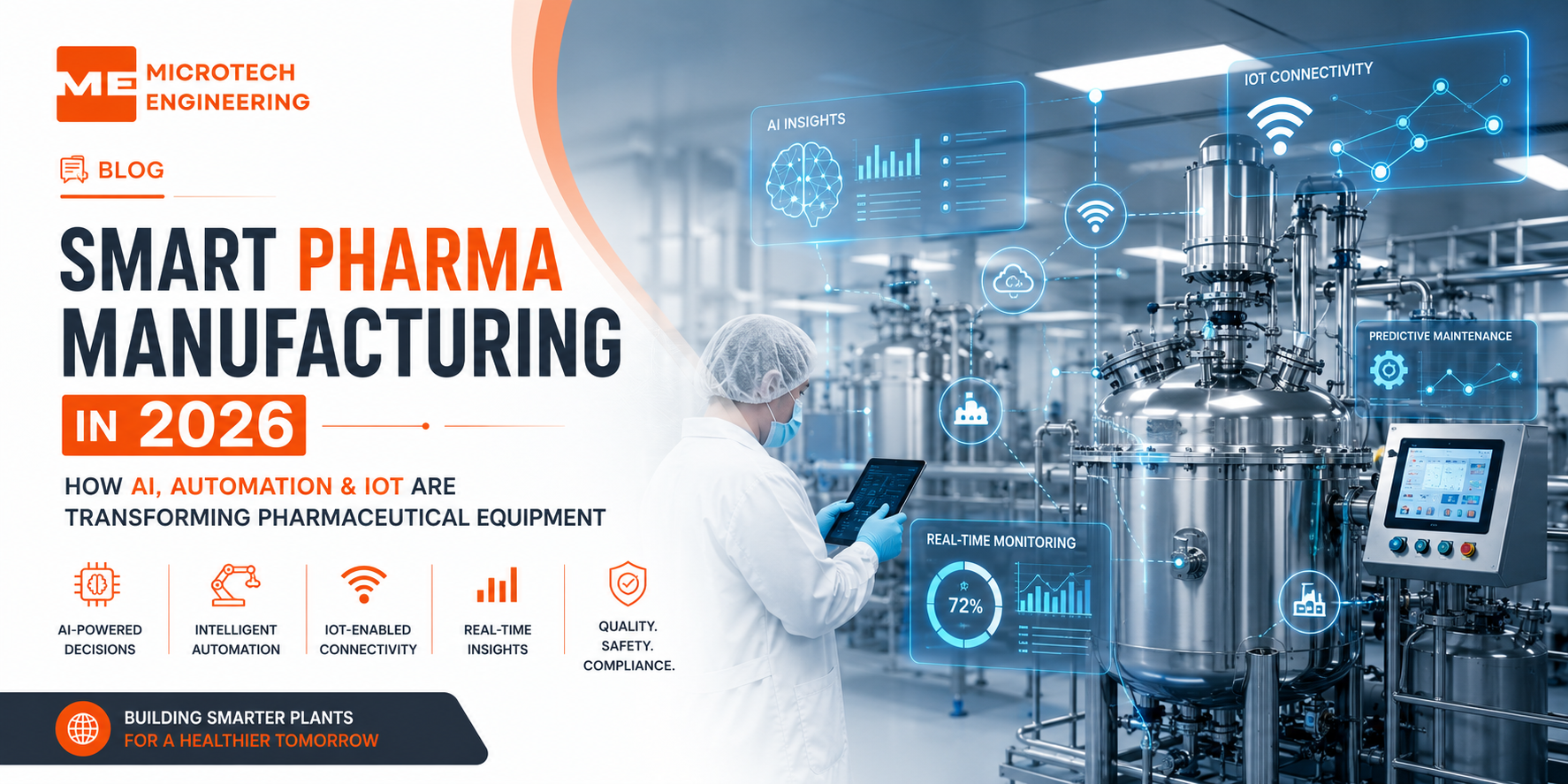
The pharmaceutical manufacturing industry is entering a new era where production is no longer driven solely by mechanical equipment. In 2026, manufacturers are increasingly investing in smart pharmaceutical equipment that combines artificial intelligence (AI), automation, Industrial Internet of Things (IIoT), and digital monitoring to improve quality, productivity, and regulatory compliance.
Modern pharmaceutical facilities are expected to deliver consistent product quality while reducing downtime, minimizing human error, improving traceability, and meeting evolving Good Manufacturing Practice (GMP) requirements. To achieve these goals, manufacturers are moving beyond conventional processing systems toward connected, data-driven manufacturing environments.
For companies planning new facilities or upgrading existing plants, equipment selection now extends beyond vessel size and production capacity. Buyers are evaluating digital capabilities, automation readiness, energy efficiency, predictive maintenance features, and long-term scalability.
This article explores how AI, automation, and IoT are changing pharmaceutical equipment choices and what manufacturers should consider when investing in next-generation processing systems.
What Is Smart Pharma Manufacturing?
Smart pharma manufacturing refers to the integration of advanced digital technologies with pharmaceutical production equipment to create connected, automated, and data-driven manufacturing processes.
Instead of relying on manual monitoring and isolated machines, smart manufacturing connects production equipment through intelligent control systems that continuously collect, analyze, and respond to operational data.
These systems help manufacturers improve visibility across the production process while supporting higher levels of quality, efficiency, and consistency.
Key technologies include:
- Artificial Intelligence (AI)
- Industrial Automation
- Industrial Internet of Things (IIoT)
- PLC & SCADA Systems
- Smart Sensors
- Digital Batch Records
- Cloud-Based Monitoring
- Predictive Maintenance
- Manufacturing Execution Systems (MES)
Why Pharmaceutical Manufacturers Are Investing in Smart Equipment
Several industry trends are accelerating digital transformation across pharmaceutical manufacturing.
Manufacturers are seeking to:
- Improve production consistency
- Reduce equipment downtime
- Increase Overall Equipment Effectiveness (OEE)
- Improve batch traceability
- Support GMP documentation
- Reduce manual intervention
- Improve production planning
- Lower operating costs
- Optimize energy consumption
- Prepare for future regulatory expectations
Smart equipment enables manufacturers to collect real-time operational data that supports faster and more informed decision-making.
How Artificial Intelligence Is Changing Pharmaceutical Manufacturing
Artificial Intelligence is moving beyond research laboratories and becoming an operational tool within pharmaceutical manufacturing. Rather than replacing operators, AI assists production teams by identifying patterns within manufacturing data and providing insights that help improve efficiency and quality.
Predictive Maintenance
AI analyzes historical equipment data to identify patterns that may indicate developing mechanical issues. Instead of waiting for unexpected failures, maintenance teams can schedule preventive maintenance before equipment performance declines. Potential benefits include reduced downtime, better spare parts planning, improved equipment availability, and lower maintenance costs.
Process Optimization
AI can evaluate production data from multiple batches to identify opportunities for improving process consistency. Manufacturers can better understand mixing performance, temperature stability, production bottlenecks, energy consumption, and equipment utilization to support continuous process improvement.
Quality Trend Analysis
AI can help quality teams review production trends by analyzing batch deviations, temperature profiles, mixing durations, equipment alarms, and cleaning records. This information supports faster investigations and process optimization.
Automation Is Becoming the Standard
Automation has become one of the most important considerations when selecting pharmaceutical processing equipment. Modern automated systems can control:
- Ingredient charging
- Mixing speed and mixing time
- Heating and cooling
- Homogenization
- Product transfer and filtration
- Valve sequencing
- Cleaning cycles
- Alarm management and batch recording
Automation helps reduce variability by executing predefined process sequences consistently. For pharmaceutical manufacturers, this supports repeatable production while improving operational efficiency.
The Growing Role of IoT in Pharmaceutical Equipment
The Industrial Internet of Things (IIoT) enables pharmaceutical equipment to communicate through connected sensors and digital networks. Instead of collecting data manually, connected equipment continuously shares information about operating conditions.
Typical data includes temperature, pressure, tank levels, flow rates, motor performance, pump status, equipment vibration, and energy consumption. Production teams can access this information in real time through centralized dashboards, enabling faster responses to production issues and supporting better operational planning.
Smart Equipment Features Buyers Should Look For in 2026
When evaluating pharmaceutical processing equipment, manufacturers are increasingly prioritizing digital capabilities alongside mechanical performance. Important features include:
- PLC-Based Control Systems: Programmable Logic Controllers automate production sequences and coordinate equipment operation.
- HMI Touchscreen Interfaces: Operators can monitor production parameters through intuitive digital displays.
- SCADA Integration: Provides centralized process monitoring, trend analysis, alarm management, and production reporting.
- Remote Monitoring: Authorized personnel can monitor equipment performance without remaining physically present at the production floor.
- Recipe Management: Predefined manufacturing recipes improve repeatability by storing approved process parameters.
- Data Logging: Automatic recording of production parameters simplifies documentation and batch review.
- Smart Sensors: Modern sensors provide continuous monitoring of temperature, pressure, flow, vacuum, tank level, conductivity, pH, and energy usage.
Equipment Becoming Smarter Across the Pharmaceutical Plant
Digital transformation is affecting nearly every category of pharmaceutical process equipment. Examples include:
- Liquid Oral Processing Plants: Smart liquid oral systems now offer automated mixing, recipe management, digital temperature control, automated product transfer, and integrated CIP sequences.
- Ointment Manufacturing Plants: Modern systems support vacuum control, programmable homogenization, digital heating and cooling, and automated batch recording.
- PW & WFI Storage Systems: Storage systems increasingly include automated circulation monitoring, digital temperature tracking, and alarm notifications.
- Pressure Vessels: Smart instrumentation enables real-time monitoring of pressure, temperature, and process conditions.
- CIP Systems: Automated CIP systems can manage cleaning cycles while recording process parameters for documentation and verification.
Industry 4.0 Is Driving Equipment Decisions
Industry 4.0 refers to connected manufacturing systems where equipment, software, and data work together. Rather than operating as independent machines, pharmaceutical equipment becomes part of an integrated production ecosystem. Benefits include improved production visibility, faster troubleshooting, better planning, higher equipment utilization, improved documentation, and reduced manual reporting.
Sustainability Is Influencing Equipment Selection
Beyond automation, sustainability has become a key purchasing factor. Modern pharmaceutical manufacturers seek equipment that helps reduce water consumption, energy usage, cleaning chemical usage, product loss, and utility costs. Energy-efficient motors, optimized heating systems, intelligent CIP cycles, and digital utility monitoring all contribute to more sustainable manufacturing operations.
Challenges Manufacturers Should Consider
Although smart equipment offers significant advantages, successful implementation requires careful planning. Manufacturers should evaluate initial investment, existing plant infrastructure, software compatibility, cybersecurity, operator training, equipment integration, validation requirements, and long-term maintenance.
Choosing the Right Pharmaceutical Equipment Partner
Selecting the right pharmaceutical machinery manufacturer is no longer based only on fabrication quality. Manufacturers should also evaluate whether suppliers provide automation expertise, PLC programming, SCADA integration, digital documentation, remote diagnostics, equipment customization, installation support, validation assistance, and after-sales technical service.
Future Outlook
Over the next several years, pharmaceutical manufacturing is expected to become increasingly connected. Emerging technologies include AI-assisted process optimization, digital twins, advanced robotics, autonomous production monitoring, predictive quality analytics, cloud-connected manufacturing, real-time equipment diagnostics, and advanced MES integration.
Conclusion
Smart Pharma Manufacturing is no longer a vision for the future—it is rapidly becoming the new standard across the pharmaceutical industry. Artificial Intelligence, automation, and Industrial IoT are transforming how pharmaceutical equipment is designed, monitored, and operated. These technologies help manufacturers improve process consistency, reduce downtime, strengthen data visibility, and support GMP-oriented manufacturing practices.
When selecting new pharmaceutical processing equipment, buyers should look beyond mechanical specifications and evaluate digital capabilities, automation readiness, scalability, and long-term operational value. Investing in intelligent, connected equipment today creates a stronger foundation for efficient, compliant, and future-ready pharmaceutical manufacturing.