
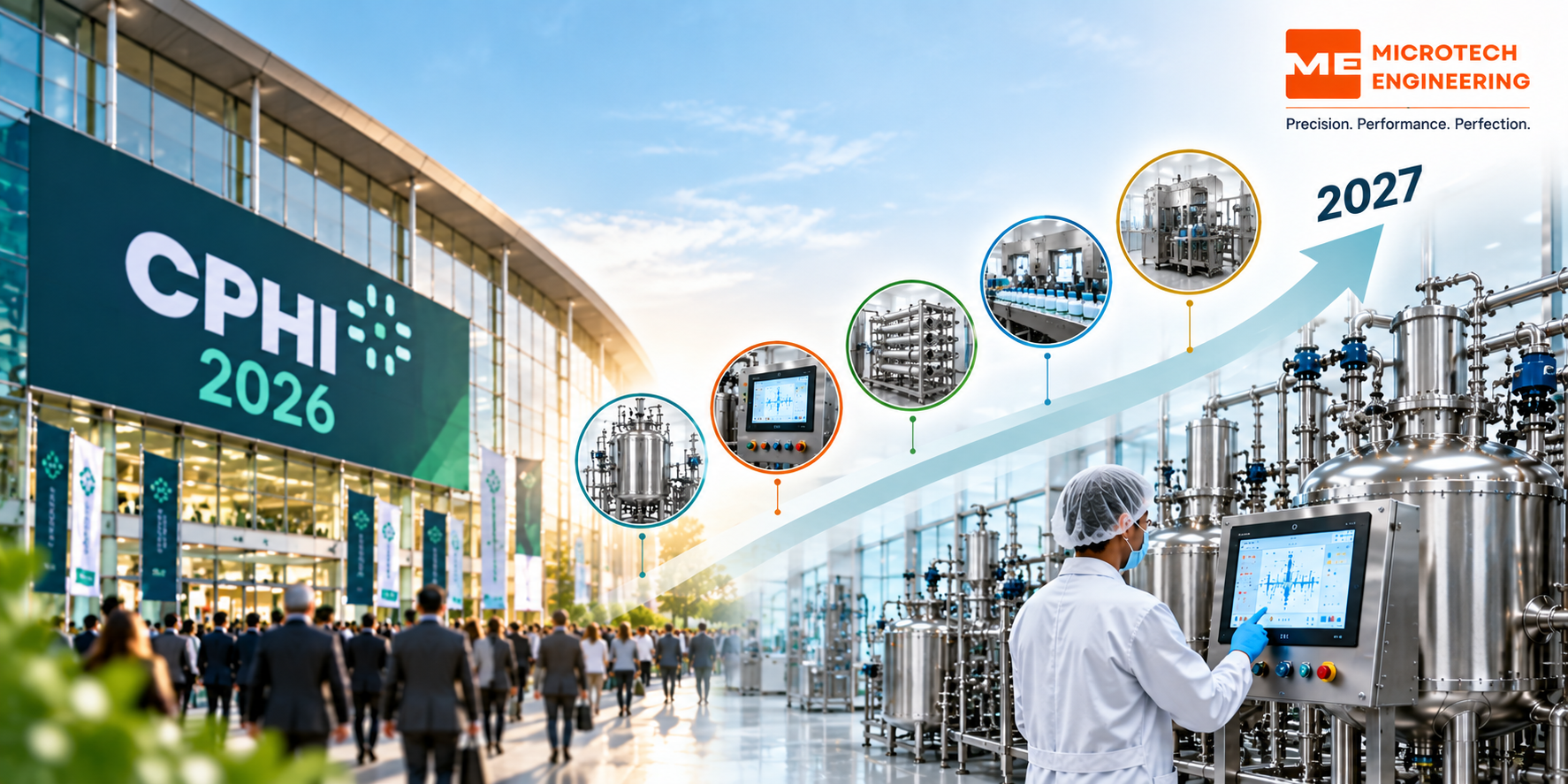
CPHI 2026 is putting several themes at the centre of pharmaceutical manufacturing: AI and digital technology, automation, contamination control, sustainability, advanced manufacturing and next-generation equipment.
The 2026 CPHI Milan event has introduced an AI & Tech zone focused on technologies including smart manufacturing, digital twins, predictive analytics and AI, while the event's machinery and equipment section continues to focus on processing, packaging and manufacturing automation. CPHI has also expanded its focus on contamination control and sustainability.
For Indian pharmaceutical manufacturers, the important question is not simply: "What new technology was displayed at CPHI?"
The more useful question is: "Which pharma equipment upgrades 2027 should actually be prioritized in an Indian pharma plant?"
This distinction matters. A pharmaceutical plant does not become future-ready simply by adding more automation, sensors or software. Equipment investments need to improve reliability, GMP readiness, process control, productivity, energy efficiency, data visibility and long-term scalability.
India's pharmaceutical manufacturing ecosystem is also continuing to move toward higher-value and more sophisticated manufacturing. The Economic Survey 2025–26 noted India's shift from a primarily volume-driven pharmaceutical industry toward greater emphasis on complex generics, biosimilars and innovation.
At the same time, government programmes such as the revised Pharmaceutical Technology Upgradation Assistance Scheme (RPTUAS) are supporting upgrades of existing pharmaceutical units to meet revised Schedule M and WHO-GMP requirements.
Against this backdrop, here are five equipment upgrade priorities Indian pharma plants should consider for 2027.
1. Upgrade to Automated and Data-Ready Process Equipment
One of the clearest takeaways from the current direction of pharmaceutical manufacturing is that automation is moving from an efficiency tool to a core manufacturing capability.
Modern pharmaceutical equipment increasingly needs to do more than perform a mechanical operation. It should also provide better process control, repeatability, monitoring, data visibility, alarm management, recipe control, batch documentation, and integration capability.
CPHI's 2026 AI & Tech focus specifically highlights smart manufacturing and digital technologies, while CPHI's coverage of AI in pharma points to manufacturing optimisation, real-time monitoring and predictive maintenance as practical applications.
What should Indian plants upgrade?
Depending on the process, manufacturers can evaluate automation upgrades for mixing systems, manufacturing vessels, liquid oral processing plants, ointment and cream manufacturing plants, homogenisers, CIP systems, transfer systems, storage systems, dryers, blenders, and utility systems.
The goal should not necessarily be a completely autonomous plant. Instead, the objective should be equipment that can reliably capture, control and communicate process information.
2. Prioritize AI, IIoT and Predictive Maintenance-Ready Equipment
The next upgrade priority is equipment that can generate useful operational data. AI is increasingly moving from theoretical discussions toward practical pharmaceutical manufacturing applications.
CPHI's 2026 AI & Tech programme specifically identifies applications such as predictive analytics, digital twins and smart manufacturing, while its manufacturing coverage highlights the potential for AI-enabled systems to predict equipment failures and optimise resource utilisation.
But there is an important point for Indian manufacturers: AI starts with equipment data. If equipment cannot provide reliable information about its operating condition, there is very little useful data for an AI system to analyse.
Depending on the equipment, relevant parameters may include temperature, pressure, vibration, flow, motor current, RPM, torque, power consumption, operating hours, valve position, vacuum, and equipment cycle count.
This creates the foundation for a more connected Pharma 4.0 manufacturing environment:
Equipment → Sensors → PLC/SCADA → Data → Analytics → Predictive Maintenance
3. Upgrade Equipment for Better GMP, Contamination Control and Validation Readiness
Digitalisation may attract attention, but GMP compliance remains one of the most important equipment considerations for pharmaceutical manufacturers.
CPHI Milan 2026 has given contamination control its own dedicated focus, reflecting the continued importance of controlled manufacturing environments and contamination prevention.
When upgrading process equipment, consider appropriate stainless steel construction (such as SS316L for product-contact parts), surface finish, hygienic design, drainability, dead-leg minimisation, weld quality, cleanability, CIP compatibility, sealing arrangements, accessibility for inspection, material traceability, equipment documentation, and calibration requirements.
4. Prioritize Energy-Efficient and Resource-Efficient Equipment
Sustainability is increasingly becoming part of pharmaceutical manufacturing strategy rather than simply a corporate reporting topic.
Instead of asking only how much equipment costs to purchase, manufacturers should also ask how much it will cost to operate over its lifecycle.
Depending on the equipment, manufacturers can evaluate high-efficiency motors, variable frequency drives, optimised agitator designs, improved heat-transfer systems, insulated vessels and pipelines, efficient pumps, optimised compressed-air systems, automated CIP sequences, reduced water consumption, and heat recovery opportunities.
Think in terms of total cost of ownership:
Purchase Cost + Energy + Water + Maintenance + Downtime + Spares + Cleaning + Lifecycle Costs
5. Upgrade Toward Flexible, Scalable and Modular Process Equipment
Pharmaceutical manufacturing is becoming more diverse. Plants may need to support multiple products, different batch sizes, product launches, contract manufacturing, export requirements, complex formulations, and changing market demand.
A modular approach can potentially make future upgrades easier. Instead of replacing an entire system, manufacturers may be able to upgrade individual components:
Existing equipment → Additional sensors → Automation upgrade → Data connectivity → Advanced analytics
5 Equipment Upgrades at a Glance
| Upgrade Priority | What to Improve | Primary Benefit |
|---|---|---|
| Automated process equipment | PLC, HMI, recipe and process control | Better consistency |
| IIoT & predictive-ready equipment | Sensors, connectivity, data capture | Better equipment visibility |
| GMP & contamination-control design | Hygienic design, cleanability, documentation | Better compliance readiness |
| Energy-efficient equipment | Motors, drives, CIP and utilities | Lower resource consumption |
| Modular & scalable equipment | Flexible capacity and automation | Future expansion |
How to Prioritize Equipment Upgrades for 2027
Not every pharmaceutical plant needs all five upgrades immediately. A more effective approach is to create an equipment modernization roadmap:
- Step 1: Audit Existing Equipment – Record age, capacity, condition, automation level, failure history, maintenance cost, energy consumption, documentation status, and data availability.
- Step 2: Identify Critical Assets – Rank equipment by Production impact + Quality impact + Safety impact + Maintenance risk.
- Step 3: Identify the Biggest Gaps – Evaluate GMP-readiness, automation, data capability, energy efficiency, cleanability, and scalability.
- Step 4: Prioritize Based on ROI and Risk – Focus on high-risk, high-business-impact assets first.
Conclusion
CPHI 2026 is highlighting an important shift in pharmaceutical manufacturing. The future is not simply about buying larger or faster machines. It is about building better-connected, more controllable, more efficient and more adaptable manufacturing systems.
For Indian pharmaceutical manufacturers planning capital investments in 2027, prioritizing automated data-ready process equipment, IIoT readiness, GMP contamination control, energy efficiency, and modular scalability will drive success.
For a detailed breakdown of CPHI 2026 takeaways and pharma equipment upgrades for 2027, evaluating long-term manufacturing capabilities rather than just initial purchase cost is key.